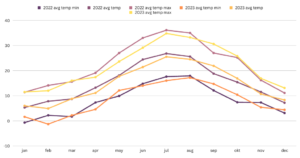
In this text, as the title suggests, we take a closer look at acids, which have become crucial from a market standpoint. We then cover some ripening mechanisms, climate influences, and possibilities for improvement in the vineyard. Naturally, all of this as simply and straightforwardly as possible.
Acids in grapes
During berry ripening, sugar increases while acids decrease. Around 90% of the acids in berries are made up of tartaric and malic acid. Other organic acids are present as well, but their influence is significantly smaller. Here is the curve that shows what happens with acids over the course of the season. It was first published by Dr. Bryan Coombe, an Australian who laid the foundations of berry ripening science back in 1975. This is also a great example of how scientific breakthroughs enable practical success, as seen in Australia and its wine industry, which grew dramatically during the 1980s and 1990s.
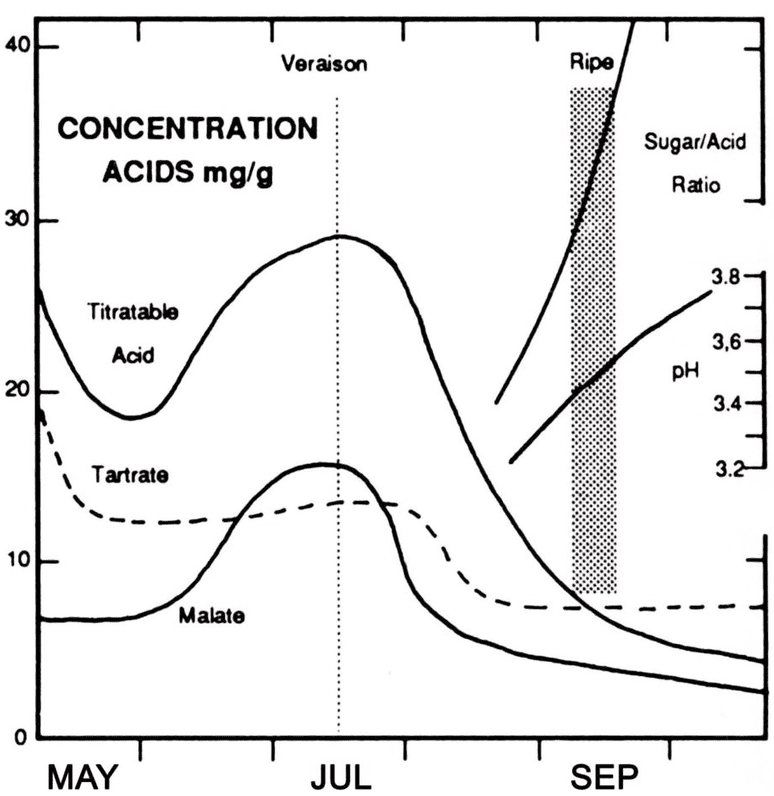
The curve shows that malic and tartaric acid behave differently during ripening. From berry formation, tartaric acid declines, while malic acid first rises and only later declines. The diagram shows their concentrations in mg/g. This measure is close to the commonly used g/L that we regularly obtain from must and wine analyses. Therefore, the diagram can be proportionally understood in g/L as well.
Besides this natural feature of the ripening process itself, the amount of acids is determined by two more things: climatic characteristics in the vineyard and the variety being grown. These two things aren’t entirely separate, since some varieties prefer only a certain type of climate.
Here’s an important note. To measure acids, pH value is almost always used alongside acid concentration itself. And this is where things get more complicated, because potassium ions enter the equation. Namely, although potassium is essential for the grapevine, if there’s too much of it for the vine’s needs, its ions displace hydrogen ions in the acids. This forms salts and raises the pH. Put simply, “potassium can neutralize acids while still in the berries.”
And pH isn’t just a number on an analysis. Above pH 3.65, free SO₂ rapidly loses effectiveness, which directly threatens the microbiological stability of the wine. That’s why high pH combined with seemingly satisfactory total acidity isn’t a harmless combination — and that’s the most common scenario in warm years.
Climate influence
Climate exerts its greatest influence through modulation of the mechanism known as malic acid respiration. Namely, the grapevine uses malic acid as one of its cellular energy sources. It’s synthesized before veraison, as an energy reservoir. From veraison onward, its consumption increases, resulting in a drop in its concentration.
In climates with higher temperatures during the growing season (GST – growing season temperature), malic acid levels are, as a rule, lower. The vine consumes more malic acid when it’s warmer, both during the day and at night. With rising average temperatures in the Balkans, this trend is exactly what’s being observed. Cool nights can mitigate this effect. With lower nighttime temperatures, the vine slows down its physiological activities, requiring less energy, and thus slowing the consumption of malic acid.
In warmer climates, tartaric acid levels are also lower. It isn’t, however, an energy source, so it isn’t consumed in the same way. But in warm climates, it binds more with potassium.
It has also been shown, as in this study, that the key temperature effect is specifically the temperature of the bunch and berry itself. The higher it is, the lower the acids.
Variety characteristics
White Varieties
White varieties, since they prefer cooler climates, generally have higher acidity. The typical ratio of tartaric to malic acid concentration at harvest time for them varies from 1:1 to 4:1. This ratio holds even for white varieties from warmer climates — take, for example, Pošip and Grk from Dalmatia, where for the 2009, 2010, and 2011 harvests, ratios ranged from 2.5:1 to 3.5:1.011 harvests.
More on varietal variability using the example of a wine-growing region in Bosnia and Herzegovina.
Black varieties
Black varieties are usually from warmer climates, and their typical ratios of tartaric to malic acid concentration are from 2:1 to 5:1. Corvina and Pinot Noir are, in a way, exceptions to this. Corvina naturally has high malic acid, often in a 1:1 ratio. That’s why it can withstand drying during the appassimento process and retain its acids. Pinot Noir is grown almost exclusively in cool locations, so its acid ratio is 1.5:1 to 2:1.
What can be done in the vineyard?
A few concrete measures can be applied depending on the stage the vineyard is in.
- Choice of variety and planting site. Here, climate profile and analysis of growing season temperature and nighttime temperatures are of particular importance.
- Plant health, photosynthesis, and a well-ventilated canopy. These measures allow for greater acid accumulation in berries before ripening and veraison begin.
- Shading the bunch zone with nets or leaf cover from veraison to harvest. This measure lowers bunch temperature and the berry surface area exposed to direct sunlight.
- If you irrigate, choose certain irrigation strategies that reduce nighttime plant activity.
- Paying attention to potassium in fertilization, both in the soil and in the vine.
Conclusion
It’s clear that Winessense is the right tool for tracking all the climate effects that directly influence acids. However, data is only the basis for activities in the vineyard. Acid levels this year will depend quite a bit on how dry and hot August turns out to be. We hope that with a bit of our own work, the result will still be excellent.