When we talk about water in the vineyard, or in agriculture in general, the first thing we need to look at is the soil. There’s an old pedological map, now part of more distant history, showing almost 30 different soil types across the territory of former Yugoslavia and the wider region. Although it dates from decades ago, this information is still significant today.
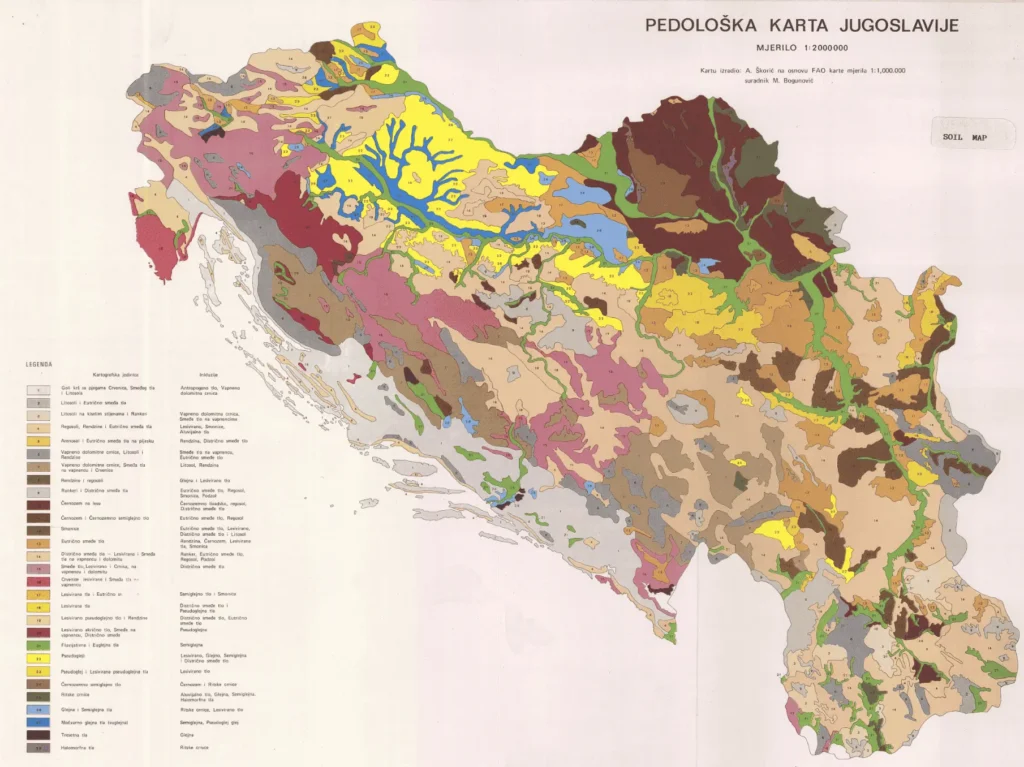
The soil type on a specific plot largely determines how much water it can physically retain and how much will be available to the vineyard during the season. And that question leads us directly to a concept every serious viticulturist should know well: available water capacity of the soil. Although it sounds like an academic term, in practice it determines whether the vine will have enough water during critical growth stages or whether it will face stress that directly affects yield and wine quality. Below, we explain exactly what available water capacity means, how it differs from related indicators, how much water different soil types can store, and what that directly means for a vineyard in the field.
Soil as a water reservoir
We can think of soil as a reservoir for water — although, in a more general sense, it’s much more than that. Every reservoir, regardless of what it stores, raises the same question: what is its maximum capacity? For soil, the answer depends primarily on its mechanical structure and type. That’s exactly why there’s a measure describing the maximum amount of water soil can hold — known as field water capacity.
However, field water capacity alone doesn’t tell us how much water is actually available to the vine. The plant accesses water exclusively through its root system, and the roots can’t make use of every water molecule in the soil. Water molecules are bound to each other by attractive forces, while soil particles simultaneously bind them strongly to themselves. These two processes form a thin, nearly impermeable layer of water that root hairs are unable to penetrate. That’s why only the available water capacity remains accessible to plants — a value more significant in viticulture than field water capacity, as it represents the water in the soil that is actually accessible to plants.
By definition, available water capacity is always lower than field water capacity. At the same time, it signifies the upper limit — the highest, yet practically effective, amount of water the soil can provide to the vineyard.
How much water different soils can hold
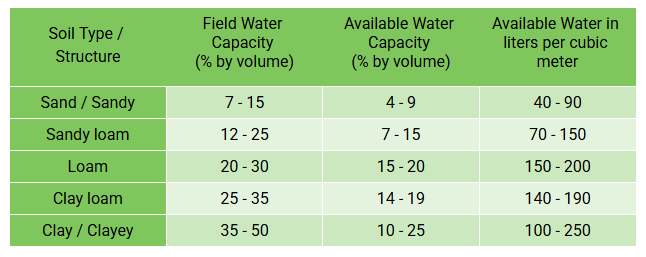
As already mentioned, available water capacity depends directly on soil type — that is, on the proportion of clay, silt, and sand in its composition. Even in the most favorable cases — certain variants of “clayey” soil — the maximum amount of water available to plants from one cubic meter of soil is around 250 liters. That’s the upper limit, and in practice it’s fairly rare.
Vineyard soils are almost always a mixture of several basic types, so it’s more realistic to expect an available water capacity below 200 liters per cubic meter. This figure shows the precise amount of rainfall required to completely refill the soil’s water supply prior to the growing season.
The table below gives an overview of field and available water capacity for the main soil types, which can serve as a framework for quickly evaluating your own site:
How much water the vine actually needs
Now it’s time to look at how much water the vine needs during the season, so that available water capacity has practical meaning. Each square meter of grapevine surface consumes between 450 and 750 liters of water throughout the growing season. From flowering to harvest, it needs between 250 and 400 liters, while during the sensitive phase from veraison to harvest, the vine requires between 25 and 50 liters. These figures clearly show why an available water capacity of only 150 to 200 liters per cubic meter of soil is often not enough without additional supply — from deeper soil layers, natural rainfall during the season, or irrigation.
How much rainfall actually reaches the reservoir
How much the soil reservoir actually gets replenished depends on the amount of rainfall during the refill period — typically from late autumn through spring, before the vine’s intensive growth begins. Regional data are usually spatial averages, so variation across microlocations within the same region can often reach up to 100 liters around the average. The table below gives an example overview of rainfall for one such period:
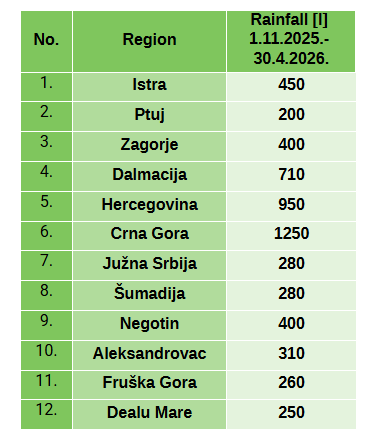
Generally speaking, regions where rainfall in this period exceeds around 300 liters per square meter usually manage to fully replenish the soil’s available water capacity, with any surplus draining into deeper soil layers or underground reservoirs. In regions where rainfall stays below that value, there’s a real possibility that the available water capacity won’t be fully replenished — partly because rainfall rarely falls evenly, and during more intense downpours part of the water simply runs off the surface instead of soaking into the soil. If there’s no additional rainfall by early summer, when the vine’s water needs aren’t yet at their peak, in regions with lower values, the real risk of drought increases as well.
What this looks like in practice: Istrian terra rossa and its water balance
To better understand how available water capacity is calculated in practice, let’s look at a concrete example — Istrian terra rossa, a clay-loamy-sandy combination rich in minerals, in which clay often makes up more than 50% of the composition. Although clay generally binds water too strongly for all of it to be usable, terra rossa — thanks to good particle aggregation and high mineral content — retains water in a state accessible to the roots, giving it an available water capacity between 150–190 liters. Terra rossa is typically found above limestone, which, thanks to cavities in its structure, stores water with an average capacity of around 220 liters per cubic meter.
Let’s take a soil profile 2 meters deep over an area of 1 square meter — that is, 2 cubic meters in total. Say the terra rossa layer is 80 centimeters thick, or 0.8 cubic meters in volume, while the remaining 1.2 cubic meters is limestone. The total capacity of the “reservoir” in this profile is:
0.8 × 190 l + 1.2 × 220 l = 152 l + 264 l = 416 liters
Let’s assume 450 liters of rainfall fell on that area. However, as much as 30% of rainfall typically falls as intense downpours during which water fails to penetrate the soil and instead runs off the surface. So the effectively available amount is 315 liters. Of that, the terra rossa layer replenishes with 152 liters, reaching its full value, while the remaining 163 liters are stored in the limestone layer. The limestone layer remains partly empty (163 out of a possible 264 liters), meaning the profile enters the season only ~76% full.
This kind of result has concrete consequences in the field. A young planting, whose roots haven’t yet reached the limestone, relies solely on the available water capacity of the terra rossa and can realistically enter the season without enough water for unimpeded development. Older plantings, with deeper, more developed root systems reaching the limestone layer, enter the growing season in a considerably more favorable water regime. In practice it’s a bit more complicated, but this calculation gives a clear picture of the logic by which soil stores and delivers water to the plant.
What to do with this knowledge in your own vineyard
Understanding the soil’s available water capacity only makes sense if it’s translated into concrete actions in the field. Five steps that can help are the following:
Track rainfall and evapotranspiration directly in your own vineyard, rather than relying solely on regional averages. A difference of just 50 liters during the berry formation stage can be decisive for the plant, and this can’t be known without local measurement. You can read more about local measurements here.
Estimate or determine the available water capacity of your specific soil, similar to the calculation in the terra rossa example. This can be done through measurement during soil analysis, more precise mechanical analysis, or, for a quicker orientation, by consulting available pedological maps of the region.
Track the level of usable water in the soil based on the previous two data points, or measure water content directly with probes designed for that purpose. This is important to do throughout the entire vineyard, since variations can be significant even over short distances.
Identify moments of actual water shortage and, where possible, compensate for them with irrigation.
Leave the analysis to experts where time or equipment for independent monitoring is lacking. These analyses can certainly be taken on by specialists in managing water regimes in viticulture.
What all of this tells us
The soil’s available water capacity is a practical measure showing how long a vineyard can “hold out” without additional water, and how serious the drought risk is in a given season. Knowing the soil type, estimating its available water capacity, and regularly monitoring rainfall and moisture in the field form the basis of any serious vineyard water management strategy — whether that strategy relies on natural rainfall or an irrigation system.