How August 2026 went
After a moderate July, August 2026 arrived. In Herzegovina it brought a whole month with temperatures above 35 °C. And it was as if there had been no rain at all, only 0.4 mm. Podgorica had 30 such days without a drop of rain in August. Here is what August 2026 looked like at representative locations.
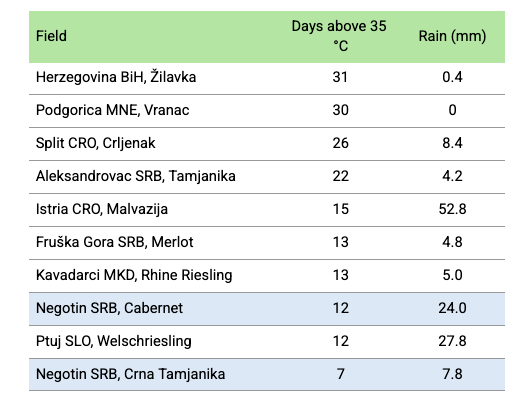
Ten fields, six countries, significant differences.
At two locations in Negotin, there were twelve hot days on one field and seven on the other. One received 24.0 mm of rain, the other 7.8.
With such differences within the same wine region, the average describes neither of them.
But these numbers don’t tell us what the consequences are either. That depends on something else. And that is what the rest of this text is about.
How many hot days did your vineyard endure?
Aleksandrovac: warmer, with fewer consequences
August 2026 in Župa was the warmest in the last three years. Twenty-two days above 35 °C, compared to sixteen in 2024.
But veraison came on August 14 this year. Twelve days later than in 2024. A colder spring slowed the vines down.
Of those twenty-two hot days, twelve came after veraison. Two years ago, fifteen came after veraison. The spring lag softened the impact of the heat somewhat.
The sum of temperatures and what lies behind it
These are two seasons from one field near Split and one field on Fruška Gora, showing data from January 1 to August 31.
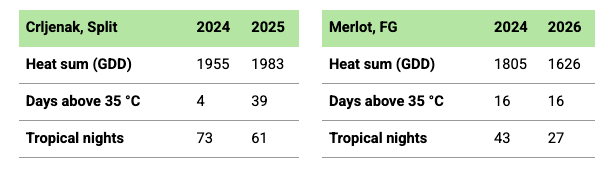
In Split, the difference in the heat sum is 1.4%. By the number we all look at, it is the same year. And yet one had four hot days, the other thirty-nine.
The same can be seen on Fruška Gora, only reversed. The 2026 season had less total heat than 2024 (1626 versus 1805 GDD), about 9% less. And it had the same number of hot days, sixteen each, but in August 13 versus 9.
How can a year with less total heat have more hot days precisely in August? Because the sum doesn’t tell you how the heat was distributed through the season. One year can have less heat overall, but more extremely hot days in a short period.
Less total heat does not mean less extreme conditions. What matters is when!
You can see how temperature sums are calculated in the text about the influence of temperature on plant growth.
The same heat, two different kinds of damage – Split
In 2024, the heat came at night. Mean daily maximum 26.8 °C, mean nightly minimum 19.5 °C, seventy-three nights that did not drop below twenty. Mild days, nights without rest.
In 2025, it came during the day. Maximum 30.1 °C, minimum 17.6 °C. Hot peaks, but the nights cooled down.
A hot day does damage that you can see. The berry overheats, sunburn appears on the sun-exposed side of the cluster, and photosynthesis simply shuts down in the afternoon: the leaf closes its stomata so as not to lose water and stops working. You notice it the same evening when you walk through the vineyard.
A warm night often doesn’t leave an immediately visible trace. The vine respires at night, and the warmer the night, the faster. And what it consumes first is the malic acid in the berry.
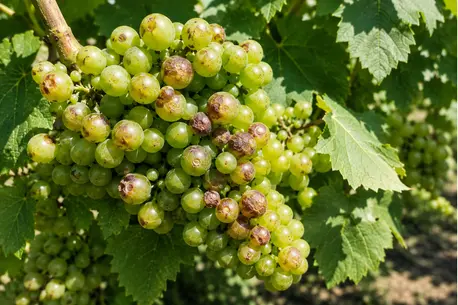
It is worth pausing here on something that is rarely mentioned. There are two main acids in grapes, malic and tartaric, and they don’t behave the same way. Tartaric acid is metabolically stable; the berry practically doesn’t touch it. Malic acid is fuel: as temperature rises, the respiratory consumption of malic acid accelerates, especially at high temperatures.
You can read more about acids in the text about acids.
That is why after a hot season you don’t lose “acidity” evenly. You lose one of the two. The wine is left with tartaric acid and without malic acid, total acidity drops less than you would expect, yet pH jumps. And in the glass this is felt as a flat wine that doesn’t look so bad by its analysis.
And how much of all this is actually damage depends on what is planted.
Crljenak is a Dalmatian variety, adapted to warmer conditions in which tropical nights are considerably more frequent. That is the climate in which it originated and in which it was selected for centuries. Tamjanika in Župa has considerably cooler nights and a day–night difference of over fifteen degrees. In aromatic varieties such as Tamjanika, warmer nights can be particularly problematic for preserving aromas and acids.
Veraison is the switch
There is another clock besides day and night: where the vine was in its season when the heat arrived.
Veraison is not just the moment when the grape changes color. It is the moment when the berry changes its job. Until then it grows: it divides cells, takes in water, builds acids. From then on it ripens: it stops growing, takes in sugar, breaks down chlorophyll, and in red varieties begins to produce anthocyanins.
With that change comes a hydraulic one. Until veraison, the berry is connected to the water supply. Water enters through the xylem, directly from the vine, and what evaporates during a hot day can be replenished during the night. After veraison the xylem’s contribution drops sharply, while the phloem becomes the dominant route by which sugars and water reach the berry. But the phloem doesn’t react to how much water there is in the soil. That is why a ripening berry is no longer hydraulically connected to the vine in the same way as before veraison.
That is why the same heat before and after veraison are not the same event. Before veraison, the vine can pull through. After, what it loses stays lost.
Two things worth knowing about veraison
The switch is individual. Veraison doesn’t happen to a cluster, it happens to a berry. In the same cluster, the first berries start up to two weeks before the last ones (depending on variety and climate), and each of them has its own date. That’s why a sample taken from one cluster at the wrong moment can misjudge the ripeness of the whole plot.
Water goes backwards too. The xylem works in both directions. After veraison, the phloem brings more water than the berry needs for growth and evaporation, and that surplus returns back to the vine. The change in the relationship between phloem inflow, water loss, and possible backflow through the xylem affects the berry’s water balance during ripening.
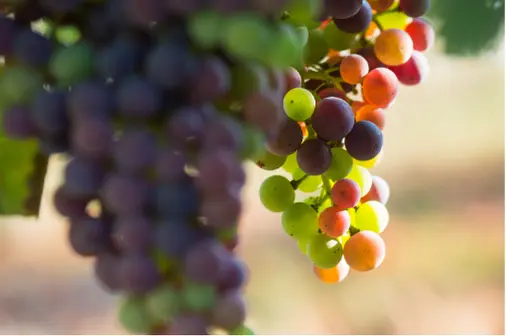
Contrary to what was long written in textbooks, the xylem does not collapse at veraison. The pipe remains intact and passable. What disappears is the pressure difference that pushed water toward the berry, so inflow practically stops even though the path is still open.
You can read more about water flow through the berry here.
The practical consequence is simple: it is not only the number of hot days in the season that counts. What counts is how many of them came after veraison.
What is important to know and why it should be measured
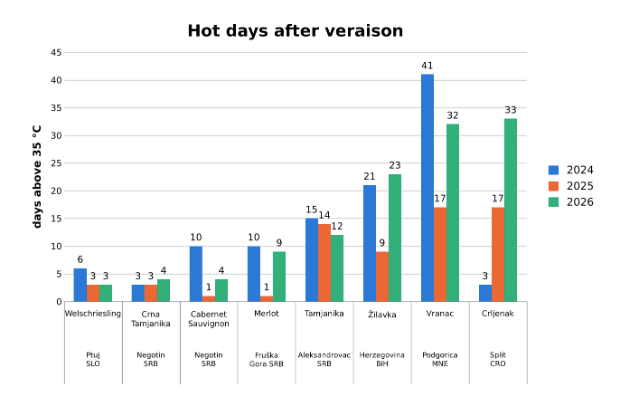
Across eight fields over three years of measurements (figure below), the number of hot days that fell during ripening ranges from three to forty-one. None of those numbers is visible in the annual average.
Podgorica had forty-one in 2024 because veraison was on July 16, so forty-seven days of ripening remained until the end of August. In Ptuj, twenty-seven remained that same year.
Three things describe a season better than any sum
1. The date of veraison. Without it, you don’t know where to draw the line, and therefore what gets counted. And it shifts from year to year on the same field by up to two weeks.
2. Hot days after veraison. Damage that you can see: sunburn, halted ripening, thin skin.
3. Tropical nights after veraison. Damage that you can’t see: malic acid that disappears while you sleep, and the pH that greets you in the analysis.
A forecast can tell you it will be hot. It cannot tell you whether the blow will come by day or by night, or whether it will fall before or after veraison. And that is precisely the difference between a year you remember for sunburn and a year you remember for flat wine.
That is exactly why Winessense doesn’t look only at how warm a plot was. We look at when the heat arrived, what stage the vine was in, and what the temperature regime was within the vineyard itself.