The vineyard season is in full swing at the beginning of July. Grapevines are currently in the berry development stage, and despite the challenges this year has brought, we expect a very good harvest. However, right now we’re entering the period when golden yellowing represents one of the greatest threats to the future of vineyards. Once golden yellowing appears, it cannot be cured — but the good news is that its spread can be successfully predicted and slowed down in time.
During this period, nymphs of the American grapevine leafhopper (Scaphoideus titanus) are already present on the underside of leaves in a large number of vineyards, while the first adults can already be found in warmer localities. This is precisely why this is the most important period for monitoring vector development and planning timely protective measures.
Golden yellowing is no longer “someone else’s problem across the border”
In Serbia, golden yellowing (Flavescence dorée) has been confirmed in northern Vojvodina, on Fruška Gora, and in the Niš region. In several areas of Fruška Gora, symptoms are now evident in nearly all vineyards examined.
The situation in the surrounding region shows how quickly the disease can progress. In Croatia, the American grapevine leafhopper is present in practically all wine-growing areas, while Slovenia is an example of how far the disease can spread if systemic control measures are not implemented.
Three Western European countries illustrate what decades of disease presence can mean. In Italy, Flavescence dorée was first detected in the late 1960s and is now present in nearly all major wine-growing regions of the north and center—including Piedmont, Lombardy, Veneto, Emilia-Romagna, and Tuscany—where mandatory control of Scaphoideus titanus and the removal of infected vines are legal requirements rather than recommendations. France, where the disease was first identified in the 1950s in Armagnac, now has more than 60% of its vineyard area under compulsory control measures, including three mandatory insecticide treatments per year in designated zones and systematic spring vineyard inspections (prospection). Spain remained an exception for many years—the leafhopper was confirmed only in 2018 in Catalonia, and the disease itself in 2020—but it has since spread toward Aragon and Navarre despite aggressive eradication efforts, demonstrating that geographic isolation and a dry climate are not permanent safeguards.
The map below, taken from a scientific paper published in 2014, shows the distribution of the American grapevine leafhopper in Europe at that time. Since then, its range has expanded further, including into Serbian territory — Vojvodina, Fruška Gora, and the Niš area.
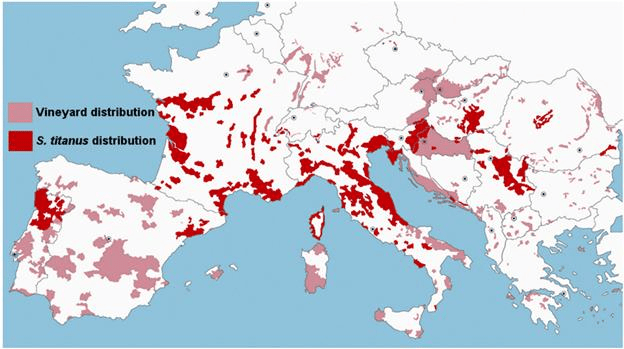
In other words, this issue is no longer limited to nearby countries. The question is no longer if the disease will appear, but how prepared your vineyard will be when it does.
A small insect, enormous damage
Scaphoideus titanus itself, known as the American grapevine leafhopper, causes almost no direct damage to the vine. The amount of plant sap it feeds on is practically negligible.
The real danger lies in what it transmits — the phytoplasma responsible for golden yellowing (Flavescence dorée).
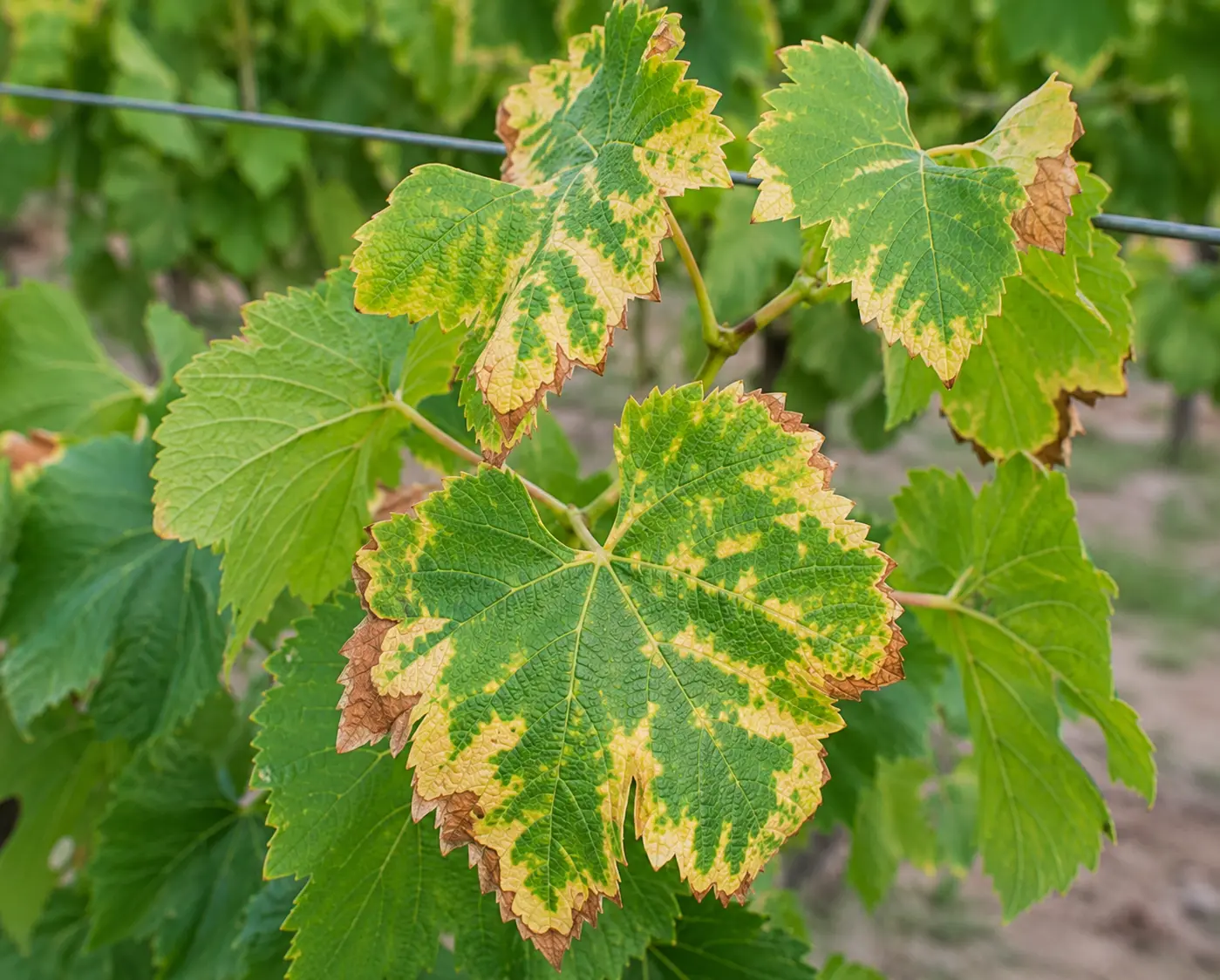
The phytoplasma colonizes the phloem, the vine’s vascular tissue, gradually disrupting the normal transport of nutrients. The consequences are severe:
- leaves curl downward,
- leaves turn yellow in white varieties,
- leaves turn red in red varieties,
- inflorescence dry out,
- clusters wilt,
- shoots remain insufficiently lignified.
In the end, the grapevine dies.
Golden yellowing cannot be cured
It’s important to be completely realistic — there is no cure for golden yellowing. There is no product that can cure an already infected vine.
The only effective measures are:
- controlling the American grapevine leafhopper,
- removing infected vines,
- preventing further spread of the disease.
Infected vines are removed throughout the growing season. When the percentage of infected plants exceeds approximately 20%, replanting the entire vineyard is often necessary.
This is why neglected, unmanaged vineyards pose a serious problem for the entire wine-growing region. They become a reservoir from which the disease spreads to neighboring, well-maintained vineyards.
Under a proposed new regulation in Slovenia, a vineyard left unmanaged for more than a year will be considered abandoned, and the owner will be required to remove it in order to prevent further spread of the disease.
Why the development of the american grapevine leafhopper matters so much
The most important part of this story isn’t the leafhopper itself, but its life cycle. The American grapevine leafhopper has only one generation per year, and its development follows a fairly predictable pattern.
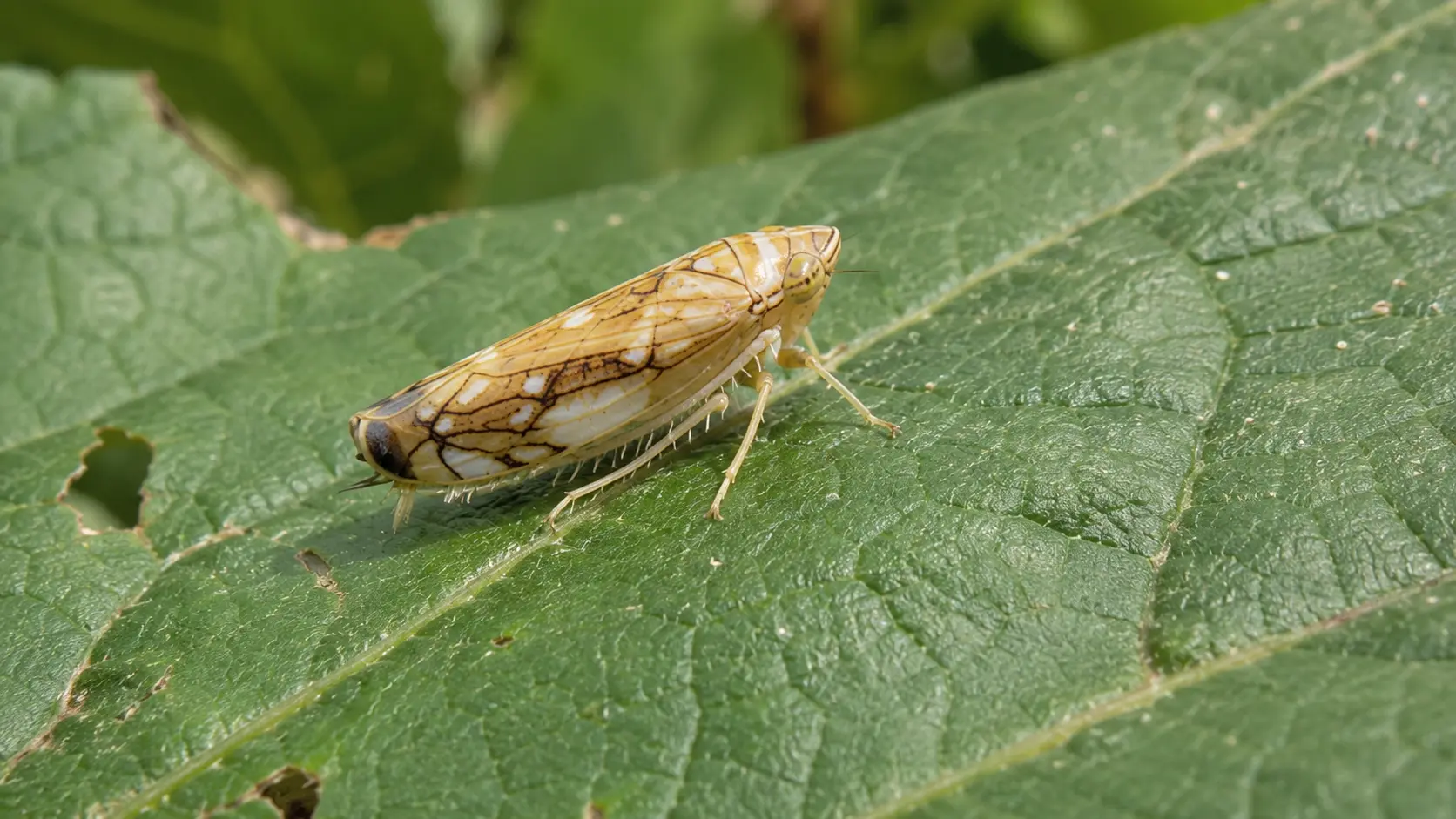
It overwinters as an egg beneath the bark of two-year-old canes. Nymphs begin hatching in mid-May and pass through five developmental instars (L1–L5).
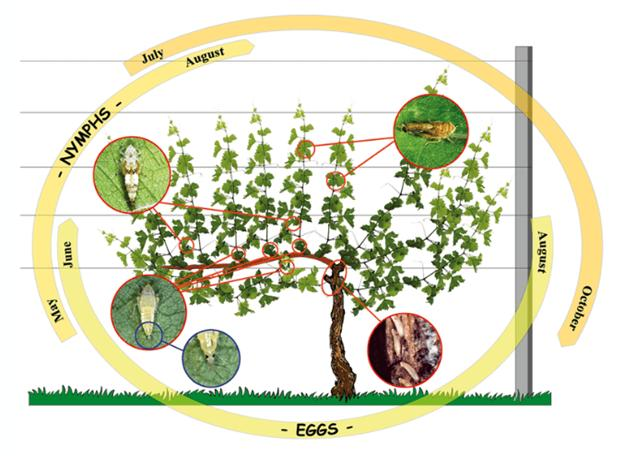
The critical moment occurs when third-instar (L3) nymphs appear. Only from this stage on are nymphs capable of transmitting the phytoplasma.
This means there is a relatively short window during which treatment is most effective — just before the majority of the population becomes infective. If treatment is applied too early, efficacy is reduced. If it’s delayed by even a few days, transmission of the disease may already be underway.
From calendar to prediction
The traditional approach relies on the calendar, regional recommendations, or grower experience. This way of working was sufficient when disease pressure was low.
Today, climate change is altering insect development dynamics. Warmer or cooler years shift developmental phases, and the microclimate of individual vineyards further affects the rate at which the American grapevine leafhopper develops. As a result, the calendar is no longer precise enough.
A predictive model that tracks climate, not the date
This year we are testing the model in several vineyards, while for next season we plan to introduce a complete predictive model.
The model uses temperature data to calculate the accumulation of heat (growing degree days, GDD) throughout the growing season — the basis for estimating the emergence of each leafhopper instar. You can read more about GDD here.
Based on this, the model estimates:
- the emergence of each larval instar,
- the onset of the L3 stage,
- the appearance of adults.
The date shifts automatically depending on the climatic conditions of each individual location.
The model’s most important recommendation is the moment when the first L3 nymphs appear. At that point, the majority of the population still consists of L1 and L2 nymphs, which are most susceptible to treatment, while at the same time the population is prevented from becoming infective.
Model results will be presented as simple development estimates for each wine-growing region, and app users will receive a notification as the optimal moment for action approaches.
Of course, a detailed protection plan should always be aligned with your agronomist’s recommendations.
What do the models show in 2026?
This year, at our monitored sites, we are recording the situation shown in the table below. Since the developmental stage in a given region depends on microclimate, for now we’ve provided a range based on conditions across multiple vineyards.
The onset of L3 marks the appearance of the first third-instar individuals, roughly 1% of the maximum number of individuals expected to appear in the vineyard. Active L3 marks the beginning of the period when third-instar individuals dominate the population (applies to vineyards with warmer climates), while first adults (estimate at time of writing) marks the moment the first adults appear. In vineyards with significant leafhopper pressure, new adults may continue to emerge over a period of 60 days or more.
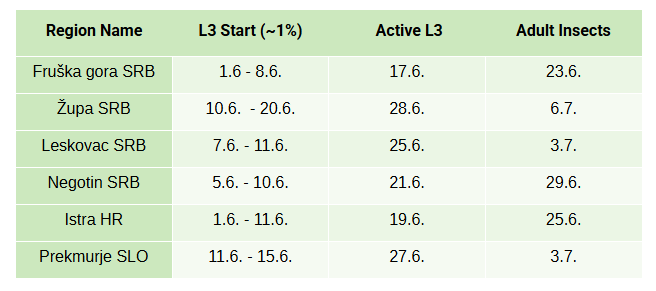
In the app, you’ll receive a notification as the key moment approaches, with a clear display of third-instar (L3) activity — so you can see at a glance whether it’s time to act or whether you should still wait.
How to monitor the american grapevine leafhopper yourself
Monitoring the American grapevine leafhopper differs depending on the developmental stage.
During May and June, young nymphs are not caught on yellow sticky traps. Instead, use:
- inspection of the underside of leaves,
- the beating tray method (tapping shoots over a white surface).
Only once adults appear, from July onward, are yellow sticky traps used — the basis of official adult flight monitoring.
If you’re monitoring conditions in your own vineyard, your observations can help validate and further improve the predictive model.
Why timely action matters more than ever
In February 2026, the European Parliament and the Council of the EU adopted a new wine package (EU Regulation 2026/471), which provides significantly greater funding opportunities for measures to combat golden yellowing.
Support may cover:
- permanent grubbing-up of infected plantings,
- vineyard restructuring,
- monitoring,
- diagnostics,
- training,
- research.
Implementation depends on each member state, so details will differ between Slovenia and Croatia. In Serbia, golden yellowing is not yet present in most wine-growing regions, so similar programs do not currently exist.
The disease cannot be cured, but it can be predicted
With golden yellowing, timing is what makes the biggest difference. Treating too early increases costs and often requires repeated spraying. Reacting too late means transmission has already begun.
This is why predicting the development of the American grapevine leafhopper is becoming one of the most important tools in modern viticulture.
The disease cannot be cured. But what happens in the vineyard can be monitored, understood, and — most importantly — predicted. This makes protection more precise, more efficient, and tailored to individual vineyard.